Friday, April 6, 2012

Paragliding in Nepal!! a Lifetime experience

0 comments Posted by beingnepali at 8:26 PM

Paragliding is a relatively new adventure sport in Nepal, and little information is available in tourist guidebooks. Paragliding in this Himalayan country can be a truly wonderful and fulfilling experience for the adventure seekers. You can experience unparalleled scenic grandeur as your share airspace with Himalayan griffin vultures, eagles, kites, while floating over villages, monasteries, temples, lakes, and jungles, with a fantastic views of the majestic Himalayas.

Gliding is a weather dependent sport and the flying season in Nepal commences from November through February, the best months being November and December. By virtue of its latitude and monsoon climate, the tree line in Nepal is at an incredible 3900m above sea level. With conditions milder than summer alpine, these are excellent and constant atmospherics. The topography and climate of Nepal also make it an ideal destination for all levels of pilots - subtropical conditions provide plenty of thermals and combined with the long valleys common in Nepal, they produce perfect "cloud streets" ideal for Para gliders, inviting them to fly along this "sky highway. The local microclimate, controlled by the numerous lakes in the valley, is unique, which makes it even better for the glider.

The take off points for these flights is Sarangkot (1592m), which offers prime views of Phewa Tal and the mountains at sunrise and sunset (provided the skies are clear); the
landing is by the lake. No previous experience is required as qualified pilots provide a short briefing before launching.
Read More »

Sunday, April 1, 2012

Nepal: Chronology of Important Events

0 comments Posted by beingnepali at 2:06 AM

ca. 563 B.C. The Buddha born in Lumbini, in Tarai Region of Nepal
268-31 B.C. Ashoka establishes empire in north India
ca. A.D. 353-73 Samudragupta establishes empire in north India
400-750 Licchavi kingdom in power in Kathmandu Valley
750-1200 "Transitional" kingdom in power in Kathmandu Valley
1100-1484 Khasa Malla kings rule in western Nepal
1200-16 Arimalla, first monarch of the Malla Dynasty, rules in Kathmandu Valley
1312 Khasa king Ripumalla leads raid in Kathmandu Valley
1345-46 Sultan Shams ud-din Ilyas of Bengal leads raid in Kathmandu Valley
1382-95 Jayasthitimalla rules as king of united Malla kingdom in Kathmandu Valley
1428-82 Yakshamalla reigns--height of united Malla kingdom
1484 Malla kingdom divided; three kingdoms of Kathmandu, Bhadgaon, and Patan expand
1526 Mughal Empire established in north India
1559 Gorkha kingdom established
1606-33 Ram Shah of Gorkha reigns; Gorkha kingdom experiences first expansion. 1728 Chinese influence established in Tibet
1743 Prithvi Narayan Shah ascends to throne of Gorkha
1764 British East India Company gains control of Bengal
1768-90 Gorkha conquers Kathmandu and Patan, Bhadgaon, eastern Nepal, and western Nepal
1775 Prithvi Narayan Shah dies, first king of united Nepal
1791-92 Nepal defeated in war with China
1806 Bhimsen Thapa becomes prime minister
1809 Nepalese troops lay seige to Kangra, farthest extent of Gorkha empire
1814-16 Anglo-Nepalese War waged; Nepal defeated
1837 Bhimsen Thapa falls, beginning unstable period in court politics
1846 Kot Massacre takes place; Jang Bahadur becomes prime minister
1855-56 War waged with China
1856 Royal decree gives absolute power to prime minister and his family
1857-58 Sepoy Rebellion waged against British in north India; Nepal aids British
1858 Jang Bahadur receives title of Rana
1877 Jang Bahadur Rana dies
1885 Ranoddip Singh Rana assassinated; Bir Shamser Rana becomes prime minister
1901 Dev Shamsher Rana forced to abdicate; Chandra Shamsher Rana becomes prime minister
1914-18 Thousands of Nepalese citizens fight as soldiers for British in World War I
1923 Treaty of Friendship with Britain confirms independence of Nepal and special relationship with British Empire
1935 Praja Parishad established, first political party in Nepal
1939-45 Tens of thousands of Nepalese citizens fight as soldiers for British in World War II
1947 Nepali National Congress established through merger of former All-India Nepali National Congress with Nepalese Society of Banaras and Gorkha Congress of Calcutta
1948 Prime Minister Padma Shamsher Rana announces first constitution of Nepal, then resigns; his replacement, Mohan Shamsher Rana, represses opposition
1950 Nepali National Congress absorbs Nepal Democratic Congress and becomes Nepali Congress Party; civil war breaks out
1950-51 Ranas fall; King Tribhuvan regains control over army and administration; interim constitution enacted
1952 King Mahendra Bir Bikram Shah Dev ascends throne
1955 Nepal admitted to United Nations
1956 First Five-Year Plan of economic development initiated
1959 King Mahendra enacts new constitution; first general elections in Nepal bring to power Nepali Congress Party with B.P. Koirala as prime minister
1960 King Mahendra dismisses the democratic government and imprisons B.P. Koirala and other leaders
1962 War waged between India and China; new constitution sets up panchayat system
1963 First elections held to National Panchayat
1972 King Birendra Bir Bikram Shah Dev ascends throne
1980 National Referendum supports panchayat system
1982 B.P. Koirala, Nepali Congress Party leader, dies
1986 Second elections held to National Panchayat
1989 Failure to renegotiate trade and transit treaties with India disrupts economy
1990 New constitution promulgated as result of agitations and successes of Movement for the Restoration of Democracy
1991 Elections held to Parliament; first session of first multiparty Parliament held in thirty-two years
Read More »

RANA RULE: The Kot Massacre

0 comments Posted by beingnepali at 2:05 AM
The death of Mathbar Singh set the stage for one of the crucial sequences of events in modern Nepalese history--the destruction of the old aristocracy and the establishment of a dictatorship of the prime minister. These events provided the long period of stability the country needed but at the cost of political and economic development.


The Kot Massacre

After three months of squabbling, a coalition ministry was formed in September 1845, again headed by Fateh Jang Chautaria. The real power behind the throne was the favorite of Queen Lakshmidevi, Gagan Singh, who controlled seven regiments in the army compared to the three under the prime minister. Abhiman Singh and Jang Bahadur also served as commanders, each with three regiments. Plots and counterplots continued until Gagan Singh was found murdered during the night of September 14, 1846. The queen was beside herself at the death of her favorite, whom she had hoped to use to elevate her own son to the monarchy. She commanded Abhiman Singh to assemble the entire military and administrative establishment of Kathmandu immediately at the courtyard of the palace armory (kot).

Emotions ran high among the assembled bands of notables and their followers, who listened to the queen give an emotional harangue blaming the Pandes and demanding that the prime minister execute the Pande leader whom she suspected of the murder. While Abhiman Singh hesitated, fighting broke out in the crowd, and he was wounded. During the free-for-all that followed, swords and knives were used on all sides to dispatch opponents. Through some scheme that has never been explained adequately, the only leader with organized bodies of troops in the kot area was Jang Bahadur, whose troops suppressed the fighting, killing many of his opponents in the process. When the struggle subsided, the courtyard was strewn with the bodies of dozens of leading nobles and an unknown number of their followers--the cream of the Nepalese aristocracy. The Pande and Thapa families in particular were devastated during this slaughter.

Why the Kot Massacre took place has never been established, although the queen herself was obviously at fault for calling the assembly and whipping it into a frenzy. It has always seemed suspicious that the king was notably absent when the fighting began and that Jang Bahadur was the only leader who was ready for trouble. The extent of the carnage was apparently unexpected. Jang Bahadur was the only true beneficiary of the massacre and became the only military leader in a position of strength in the capital. The next day, he became prime minister and immediately launched a purge that killed many of his aristocratic competitors and drove 6,000 people into exile in India.
Read More »

World's Longest bungy Jumping in Nepal

0 comments Posted by beingnepali at 1:49 AM

Bungy Jumping


Ultimate Bungy at The Last Resort in Nepal may be the most spectacular Bungy Jump on the Planet. This remarkable 500ft (160m) drop into the Bhoti Koshi River gorge on the Nepal/Tibet border is the longest Free-fall in the world. Designed, constructed and operated by very experienced Kiwis to exacting international standards your safety is guaranteed. It is Nepal's Ultimate Rush.
The bungy jump site is located 100km outside Kathmandu and accessible by 300 hours bus ride on Kathmandu-Tibet highway. The jump takes place on a 166m wide steel suspension bridge over the Bhotekoshi River Gorge. The bridge is Swiss designed, especially for bungy jumping with a 4X safety factor. The bridge has loading capacity of 41,500 kg (4.5 tones). Safari tented accommodation (The Last Resort) with restaurant is available here for those willing to stay overnight and participate other activities like canyoning, rafting, rock climbing .
We invite you to experience the ultimate rush in the surroundings of this amazing place. Combined with the luxury and uniqueness of our resort, we consider this the Ultimate Bungy Experience.

Read More »

Nepalese Peoples War

0 comments Posted by beingnepali at 1:26 AM

Timeline

1996

  • February 13 Initiation of the people's war by the Communist Party of Nepal.
  • Kathmandu: A soft-drink bottling factory owned by a multi-national company was attacked and a portion of the building torched. 
  • Gorkha district : A liquor factory was 'blasted'. 
  • Office of the Small Farmer's Development Programme of the state owned Agricultural Development Bank in Chyangli VDC (Village Development Committee) ransacked.
  • Kavre district: An usurer's house was raided at night, properties and cash reportedly worth 1.3 million rupees were seized, and loan documents worth several million rupees reportedly destroyed.
  • Rolpa, Rukum & Sindhuli districts: One police outpost raided in each district. The outpost at Holeri, Rolpa had its store seized, including a "substantial amount of high explosives". Athbiskot-Rari, Rukum was also raided. The Sindhuligarhi post in Sindhuli was reportedly raided without resistance.

2001

  • May 28: Chairman Prachanda gave an interview with the journal A World to Win.
  • November: Peace talks collapse.

2002

  • US Congress approves US$12 million to train Royal Nepal Army officers and supply 5,000 M-16 rifles. 
  • May: Peace talks collapse.
  • May 11 A photograph found by Nepalese soldiers in western Nepal depicts Nepalese Maoist rebel leaders Baburam Bhattarai, Hishila Yami, Ram Bahadur Thapa (alias Badal), and Pushpa Kamal Dahal (alias Prachanda). 

2003

  • January: The United States held exercises with the Nepali army. 
  • January 29 A ceasefire is established and peace talks begin. 
  • August 17 Killing of '19 rebels and civilians' in the Ramechhap district of central Nepal.
  • August 24 The Maoists threatened to withdraw from the cease-fire if the government would not agree to include discussion of their participation in the Constituent Assembly within 48 hours. 
  • August 26 Maoist ultimatum expires. 
  • August 27 Strike. "the rebels called for a one-day strike to denounce the army's attacks on rebel cadres" 
  • The rebels unilaterally withdrew from the January 29th cease-fire. Prachanda's statement revived the rebels' demand for an end to monarchic rule in favor of a people's republic. Excerpt of statement: "since the old regime has put an end to the forward-looking solution to all existing problems through the cease-fire and peace talks, we herein declare that the rationale behind cease-fire...and peace process has ended." 
  • September 27 "Twelve Maoists were killed in a gunbattle with security forces at Chhita Pokhara in the Khotang district, 340 kilometres east of Kathmandu, a police officer said." "Elsewhere in eastern Nepal, the Maoists killed two policemen, Purna Giri and Radha Krishna Rai, and a woman selling beetle nuts, Kala Chaudhary, in the Jaljale-Gaighat area, an official said." "In Janakpur, an industrial hub on the Indian border 260 kilometres south-east of Kathmandu, the rebels carried out five early morning bombings that disrupted telephone service and power, police said." "He said the sites that were bombed included the offices of the roads department and the Nepal Electricity Authority and a telecommunications tower." "Troops and Maoists traded fire for nearly 40 minutes after the blasts but the rebels escaped and no one was injured, Mr Khadka said." 
  • October 13 At least 37 people were killed when an estimated 1,000 Maoists attempted to storm a police training centre in Bhaluwang. "The rebels had snapped telephone cables, set up roadblocks by felling trees or blowing up highway bridges to prevent reinforcements from coming," a witness, Krishna Adhikary, told Reuters. 
  • October 27 "Lieutenant Colonel Adrian Griffith and six Nepali nationals were freed last week 42 hours after being taken captive in Baglung, 300 km (190 miles) west of Kathmandu, while on a drive to recruit young Gurkha soldiers to serve in the British army." Party chief Prachanda said "We are sorry for the incident that took place against the policy of the party". 
  • November 11 The government Defence Ministry accused the rebels of abducting twenty-nine 9th and 10th grade students from Riva Secondary School in Mugu district, western Nepal during the previous week. 
  • November 19 According to a Nepalese army official, four people were caught at the Chinese Khasa border point, 114 kilometres northeast of Kathmandu, smuggling weapons from Tibet in to Nepal. The official named Hirala Lal Shrestha and Gyaljen Sherpa and said they were taken for interrogation in the Tibetan town of Xigatse. 

2004

  • February 5 A government raid on a village in Bhimad, Makwanpur district occurred. Reports emerged that 14 suspected Maoist activists and two civilians were extrajudicially executed. Amnesty International later wrote a letter to Prime Minister Surya Bahadur Thapa and Colonel Nilendra Aryal, Head of the Royal Nepal Army (RNA) human rights cell demanding an immediate inquiry. 
  • February 10 Two central committee members of Communist Party of Nepal Matrika Yadav and Suresh Alemagar were reported to have been handed over by India to Nepal. They were reportedly arrested in Lucknow after Nepal provided information. 
  • February 13 Ganesh Chilwal leads an anti-Maoist protest on this day, the ninth anniversary of the commencement of the revolution. 
  • February 15 Ganesh Chilwal, a Nepalese anti-Maoist leader was shot dead in his Kathmandu office by two men. The attack came two days he had led an anti-Maoist protest. 
  • February 15 Fighting erupted at a Maoist jungle base in Kalikot district, 360km west of Kathmandu. The base was said to hold 1000 Maoist troops. 
  • On February 17, a security official said a private helicopter flying troops to Kalikot was hit by Maoist fire but that it returned safely to Kathmandu. 
  • OnFebruary 18, 65 were reported killed, though this conflicted with other reported death tolls of 35 and 48. 
  • February 15 and 16 State radio reported 13 rebels were killed in seven separate small clashes across the kingdom. 
  • February 18 Lawmaker Khem Narayan Faujdar, a member of the parliament dissolved by King Gyanendra in 2002 was shot dead by two suspected Maoists riding a motorcycle in the Nawalparasi district, 200km southwest of the capital, according to police. 
Read More »

Jungle Safari In Nepal

0 comments Posted by beingnepali at 12:48 AM
Nepal is a country of exceptional biodiversity and a beautiful natural environment. The tropical jungles of the Terai preserve some of the best wildlife habitat in the subcontinent. Nepal has 16 national parks, wildlife reserves and conservation areas, occupying 16 percent of its total geographical area.


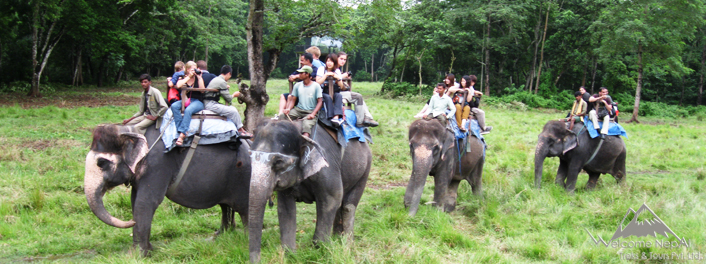
For those who wish to experience the natural environment at its best there is no better place to visit than Nepal. The outdoor adventure sports into the wilderness to see wild animals, birds and natural beauty. You ride on an elephant's back or on a four wheeler jeep accompanied by a fully trained guide (also known as expert Naturalists) for the love of nature and animals. In Nepal, Chitwan and Bardia are two hot dishes on the menu. Pick Chitwan as this is Nepal's most popular National Park offering excellent opportunity to see Royal Bengal Tigers, One horned Rhino, crocodile and thrilling wilderness experience into its deep and thick jungle. Pick Bardia also, as this is another National Park, which offers excellent jungle safari. Here too you can ride on an elephant or a take four wheel to discover some of Nepal's unspoiled natural habitats.


Most jungle safari consists of canoe rides on the jungle rivers, nature walks, birds watching excursions and quick tours around the villages to discover unique culture and traditions of the local village people. There are also scheduled cultural-musical programs performed by the villages, which are also in the Jungle Safari itinerary.

Chitwan and Bardia national park are the best place for this:


Royal Chitwan National Park

Chitwan national park is situated in southwestern of Nepal and covers 932 sq. km. This is Nepal’s first famous national park for the wildlife safaris. You can see wild elephant; white footed gaur (the world’s largest wild cattle), leopards, wild boar, sloth bear and several species of deer including the spotted, barking, samber and hog deer. It is the home of the one-horned rhinoceros and harbors one of the largest populations of the exclusive and rare Royal Bengal tigers. The swampy areas and numerous ox-bow lakes are a prefect for marsh crocodiles. The park hosts 450 species of birds. The Tharu people who have unique cultural traditions. In Chitwan there are many hotels inside and outside of the park. Usually visitors spend 3 days and 2 nights, but it is also possible to stay longer if you desire.

How much will it cost?
Cost mainly depends on your duration of stay and your choice of accommodation. Most jungle safari packages are for 2 nights to 3 days costing on average US$ 70 to 400 which includes transportation, food, and accommodation, all the activities in the park and park fee.Note: We do our best to make your visit as best as possible, so please contact us for more information.What to bring with you?
1. Binoculars
2. Sun Hat and Sun Cream
3. Swim Wear
4. Light Clothes; Color should blend with natural surroundings
5. Light sweater or jacket for mornings and evenings during the winter season (Dec to Feb)
6. Shoes for easy movement
7. Flashlight
8. Swiss knife
9. Reading books

A Typical Safari Package:
Days 01 :
1:00 pm Arrive Lunch
3:30 pm Elephant Safari / Jungle Walk / Mature Walk with Boat Ride
8:00 pm Dinner.

Days 02 :
5:30 am Wake up call followed by tea/coffee.
6:00 am Bird watching / Elephant Safari / Jungle walk.
8:00 am Breakfast.
9:30 am Crocodile walk. A 45 minutes walk through grass land and forest upstream of the Narayani or Rapti rivers. Board boats to observe the wild life whilst floating back to camp.
1:00 pm Lunch.
3:30 pm Elephant Safari /Jungle Walk / Visit Observation Tower / Nature Walk with Boat Ride.
8:00 pm Dinner.

Days 03 :
5:30 am Wake up call followed by tea/coffee.
6:00 am Bird Watching / Elephant Safari / Jungle Walk.
8:00 am Breakfast.
9:30 am Departure.


Royal Bardia National Park

Established in 1984, this park is situated in Nepal’s western Terai. It covers 968 sq. km. The park offers a variety of experiences in its vast undisturbed wilderness. About 70% of the forest consists of sal trees (which are used for the beautifully carved windows in Kathmandu) with a mixture of grass land and riverine forest. The park is home to endangered animals such as the Bengal tiger, wild elephant, greate. One-horned rhinoceros, swamp deer, and black buck. Other endangered species include gharial crocodile, marsh mugger and Gangetic dolphin, 200 species of birds and several species of snakes can also be seen in the park. Certain ethnic groups live in the park as well and you can experience their culture and traditions

How much will it cost?
Cost mainly depends on your duration of stay and your choice of accommodation. Most jungle safari packages are for 2 nights to 3 days costing on average US$ 70 to 400 which includes transportation, food, and accommodation, all the activities in the park and park fee.Note: We do our best to make your visit as best as possible, so please contact us for more information.What to bring with you?
1. Binoculars
2. Sun Hat and Sun Cream
3. Swim Wear
4. Light Clothes; Color should blend with natural surroundings
5. Light sweater or jacket for mornings and evenings during the winter season (Dec to Feb)
6. Shoes for easy movement
7. Flashlight
8. Swiss knife
9. Reading books


Read More »

The Early Kingdom of the Licchavis, 400-750

0 comments Posted by beingnepali at 12:09 AM
Amshuverma: Licchavi king of nepal
In the late fifth century, rulers calling themselves Licchavis began to record details on politics, society, and economy in Nepal. The Licchavis were known from early Buddhist legends as a ruling family during the Buddha's time in India, and the founder of the Gupta Dynasty claimed that he had married a Licchavi princess. Perhaps some members of this Licchavi family married members of a local royal family in the Kathmandu Valley, or perhaps the illustrious history of the name prompted early Nepalese notables to identify themselves with it. In any case, the Licchavis of Nepal were a strictly local dynasty based in the Kathmandu Valley and oversaw the growth of the first truly Nepalese state.

The earliest known Licchavi record, an inscription of Manadeva I, dates from 464, and mentions three preceding rulers, suggesting that the dynasty began in the late fourth century. The last Licchavi inscription was in A.D. 733. All of the Licchavi records are deeds reporting donations to religious foundations, predominantly Hindu temples. The language of the inscriptions is Sanskrit, the language of the court in north India, and the script is closely related to official Gupta scripts. There is little doubt that India exerted a powerful cultural influence, especially through the area called Mithila, the northern part of present-day Bihar State. Politically, however, India again was divided for most of the Licchavi period.

To the north, Tibet grew into an expansive military power through the seventh century, declining only by 843. Some early historians, such as the French scholar Sylvain Lévi, thought that Nepal may have become subordinate to Tibet for some time, but more recent Nepalese historians, including Dilli Raman Regmi, deny this interpretation. In any case, from the seventh century onward a recurring pattern of foreign relations emerged for rulers in Nepal: more intensive cultural contacts with the south, potential political threats from both India and Tibet, and continuing trade contacts in both directions.

The Licchavi political system closely resembled that of northern India. At the top was the "great king" (maharaja), who in theory exercised absolute power but in reality interfered little in the social lives of his subjects. Their behavior was regulated in accordance with dharma through their own village and caste councils. The king was aided by royal officers led by a prime minister, who also served as a military commander. As the preserver of righteous moral order, the king had no set limit for his domain, whose borders were determined only by the power of his army and statecraft--an ideology that supported almost unceasing warfare throughout South Asia. In Nepal's case, the geographic realities of the hills limited the Licchavi kingdom to the Kathmandu Valley and neighboring valleys and to the more symbolic submission of less hierarchical societies to the east and west. Within the Licchavi system, there was ample room for powerful notables (samanta) to keep their own private armies, run their own landholdings, and influence the court. There was thus a variety of forces struggling for power. During the seventh century, a family known as the Abhira Guptas accumulated enough influence to take over the government. The prime minister, Amsuvarman, assumed the throne between approximately 605 and 641, after which the Licchavis regained power. The later history of Nepal offers similar examples, but behind these struggles was growing a long tradition of kingship.

The economy of the Kathmandu Valley already was based on agriculture during the Licchavi period. Artworks and place-names mentioned in inscriptions show that settlements had filled the entire valley and moved east toward Banepa, west toward Tisting, and northwest toward present-day Gorkha. Peasants lived in villages (grama) that were administratively grouped into larger units (dranga). They grew rice and other grains as staples on lands owned by the royal family, other major families, Buddhist monastic orders (sangha), or groups of Brahmans (agrahara). Land taxes due in theory to the king were often allocated to religious or charitable foundations, and additional labor dues (vishti) were required from the peasantry in order to keep up irrigation works, roads, and shrines. The village head (usually known as pradhan, meaning a leader in family or society) and leading families handled most local administrative issues, forming the village assembly of leaders (panchalika or grama pancha). This ancient history of localized decision making served as a model for late twentieth-century development efforts.
Read More »
 

Popular Posts

Total Pageviews

© 2012 SOFTECHNOGEEK. All Rights Reserved.