Sunday, April 1, 2012

Jungle Safari In Nepal

0 comments Posted by beingnepali at 12:48 AM
Nepal is a country of exceptional biodiversity and a beautiful natural environment. The tropical jungles of the Terai preserve some of the best wildlife habitat in the subcontinent. Nepal has 16 national parks, wildlife reserves and conservation areas, occupying 16 percent of its total geographical area.


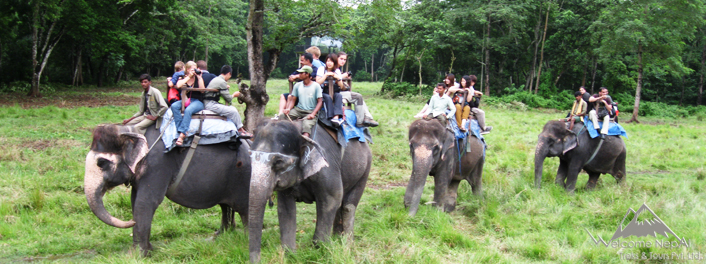
For those who wish to experience the natural environment at its best there is no better place to visit than Nepal. The outdoor adventure sports into the wilderness to see wild animals, birds and natural beauty. You ride on an elephant's back or on a four wheeler jeep accompanied by a fully trained guide (also known as expert Naturalists) for the love of nature and animals. In Nepal, Chitwan and Bardia are two hot dishes on the menu. Pick Chitwan as this is Nepal's most popular National Park offering excellent opportunity to see Royal Bengal Tigers, One horned Rhino, crocodile and thrilling wilderness experience into its deep and thick jungle. Pick Bardia also, as this is another National Park, which offers excellent jungle safari. Here too you can ride on an elephant or a take four wheel to discover some of Nepal's unspoiled natural habitats.


Most jungle safari consists of canoe rides on the jungle rivers, nature walks, birds watching excursions and quick tours around the villages to discover unique culture and traditions of the local village people. There are also scheduled cultural-musical programs performed by the villages, which are also in the Jungle Safari itinerary.

Chitwan and Bardia national park are the best place for this:


Royal Chitwan National Park

Chitwan national park is situated in southwestern of Nepal and covers 932 sq. km. This is Nepal’s first famous national park for the wildlife safaris. You can see wild elephant; white footed gaur (the world’s largest wild cattle), leopards, wild boar, sloth bear and several species of deer including the spotted, barking, samber and hog deer. It is the home of the one-horned rhinoceros and harbors one of the largest populations of the exclusive and rare Royal Bengal tigers. The swampy areas and numerous ox-bow lakes are a prefect for marsh crocodiles. The park hosts 450 species of birds. The Tharu people who have unique cultural traditions. In Chitwan there are many hotels inside and outside of the park. Usually visitors spend 3 days and 2 nights, but it is also possible to stay longer if you desire.

How much will it cost?
Cost mainly depends on your duration of stay and your choice of accommodation. Most jungle safari packages are for 2 nights to 3 days costing on average US$ 70 to 400 which includes transportation, food, and accommodation, all the activities in the park and park fee.Note: We do our best to make your visit as best as possible, so please contact us for more information.What to bring with you?
1. Binoculars
2. Sun Hat and Sun Cream
3. Swim Wear
4. Light Clothes; Color should blend with natural surroundings
5. Light sweater or jacket for mornings and evenings during the winter season (Dec to Feb)
6. Shoes for easy movement
7. Flashlight
8. Swiss knife
9. Reading books

A Typical Safari Package:
Days 01 :
1:00 pm Arrive Lunch
3:30 pm Elephant Safari / Jungle Walk / Mature Walk with Boat Ride
8:00 pm Dinner.

Days 02 :
5:30 am Wake up call followed by tea/coffee.
6:00 am Bird watching / Elephant Safari / Jungle walk.
8:00 am Breakfast.
9:30 am Crocodile walk. A 45 minutes walk through grass land and forest upstream of the Narayani or Rapti rivers. Board boats to observe the wild life whilst floating back to camp.
1:00 pm Lunch.
3:30 pm Elephant Safari /Jungle Walk / Visit Observation Tower / Nature Walk with Boat Ride.
8:00 pm Dinner.

Days 03 :
5:30 am Wake up call followed by tea/coffee.
6:00 am Bird Watching / Elephant Safari / Jungle Walk.
8:00 am Breakfast.
9:30 am Departure.


Royal Bardia National Park

Established in 1984, this park is situated in Nepal’s western Terai. It covers 968 sq. km. The park offers a variety of experiences in its vast undisturbed wilderness. About 70% of the forest consists of sal trees (which are used for the beautifully carved windows in Kathmandu) with a mixture of grass land and riverine forest. The park is home to endangered animals such as the Bengal tiger, wild elephant, greate. One-horned rhinoceros, swamp deer, and black buck. Other endangered species include gharial crocodile, marsh mugger and Gangetic dolphin, 200 species of birds and several species of snakes can also be seen in the park. Certain ethnic groups live in the park as well and you can experience their culture and traditions

How much will it cost?
Cost mainly depends on your duration of stay and your choice of accommodation. Most jungle safari packages are for 2 nights to 3 days costing on average US$ 70 to 400 which includes transportation, food, and accommodation, all the activities in the park and park fee.Note: We do our best to make your visit as best as possible, so please contact us for more information.What to bring with you?
1. Binoculars
2. Sun Hat and Sun Cream
3. Swim Wear
4. Light Clothes; Color should blend with natural surroundings
5. Light sweater or jacket for mornings and evenings during the winter season (Dec to Feb)
6. Shoes for easy movement
7. Flashlight
8. Swiss knife
9. Reading books


Read More »

The Early Kingdom of the Licchavis, 400-750

0 comments Posted by beingnepali at 12:09 AM
Amshuverma: Licchavi king of nepal
In the late fifth century, rulers calling themselves Licchavis began to record details on politics, society, and economy in Nepal. The Licchavis were known from early Buddhist legends as a ruling family during the Buddha's time in India, and the founder of the Gupta Dynasty claimed that he had married a Licchavi princess. Perhaps some members of this Licchavi family married members of a local royal family in the Kathmandu Valley, or perhaps the illustrious history of the name prompted early Nepalese notables to identify themselves with it. In any case, the Licchavis of Nepal were a strictly local dynasty based in the Kathmandu Valley and oversaw the growth of the first truly Nepalese state.

The earliest known Licchavi record, an inscription of Manadeva I, dates from 464, and mentions three preceding rulers, suggesting that the dynasty began in the late fourth century. The last Licchavi inscription was in A.D. 733. All of the Licchavi records are deeds reporting donations to religious foundations, predominantly Hindu temples. The language of the inscriptions is Sanskrit, the language of the court in north India, and the script is closely related to official Gupta scripts. There is little doubt that India exerted a powerful cultural influence, especially through the area called Mithila, the northern part of present-day Bihar State. Politically, however, India again was divided for most of the Licchavi period.

To the north, Tibet grew into an expansive military power through the seventh century, declining only by 843. Some early historians, such as the French scholar Sylvain Lévi, thought that Nepal may have become subordinate to Tibet for some time, but more recent Nepalese historians, including Dilli Raman Regmi, deny this interpretation. In any case, from the seventh century onward a recurring pattern of foreign relations emerged for rulers in Nepal: more intensive cultural contacts with the south, potential political threats from both India and Tibet, and continuing trade contacts in both directions.

The Licchavi political system closely resembled that of northern India. At the top was the "great king" (maharaja), who in theory exercised absolute power but in reality interfered little in the social lives of his subjects. Their behavior was regulated in accordance with dharma through their own village and caste councils. The king was aided by royal officers led by a prime minister, who also served as a military commander. As the preserver of righteous moral order, the king had no set limit for his domain, whose borders were determined only by the power of his army and statecraft--an ideology that supported almost unceasing warfare throughout South Asia. In Nepal's case, the geographic realities of the hills limited the Licchavi kingdom to the Kathmandu Valley and neighboring valleys and to the more symbolic submission of less hierarchical societies to the east and west. Within the Licchavi system, there was ample room for powerful notables (samanta) to keep their own private armies, run their own landholdings, and influence the court. There was thus a variety of forces struggling for power. During the seventh century, a family known as the Abhira Guptas accumulated enough influence to take over the government. The prime minister, Amsuvarman, assumed the throne between approximately 605 and 641, after which the Licchavis regained power. The later history of Nepal offers similar examples, but behind these struggles was growing a long tradition of kingship.

The economy of the Kathmandu Valley already was based on agriculture during the Licchavi period. Artworks and place-names mentioned in inscriptions show that settlements had filled the entire valley and moved east toward Banepa, west toward Tisting, and northwest toward present-day Gorkha. Peasants lived in villages (grama) that were administratively grouped into larger units (dranga). They grew rice and other grains as staples on lands owned by the royal family, other major families, Buddhist monastic orders (sangha), or groups of Brahmans (agrahara). Land taxes due in theory to the king were often allocated to religious or charitable foundations, and additional labor dues (vishti) were required from the peasantry in order to keep up irrigation works, roads, and shrines. The village head (usually known as pradhan, meaning a leader in family or society) and leading families handled most local administrative issues, forming the village assembly of leaders (panchalika or grama pancha). This ancient history of localized decision making served as a model for late twentieth-century development efforts.
Read More »

Saturday, March 31, 2012

History of Nepal : A view Back

0 comments Posted by beingnepali at 11:58 PM
Nepal's diverse culture of today is a result of its close ties with its neighbors India and Tibet. Throughout its time Nepal's boundaries have fluctuated from including much of present day India to consisting of only a few city-states in the Kathmandu Valley.

With the passing of every new century, Nepal witnessed many rulers and dynasties play contributing roles in moulding Nepal to present day’s Modern Nepal.Nepal's recorded history begins in the 7th century BCE (before the Common Era). The Kiratis, Mongolian people who came to Nepal from the east, are said to have been Nepal's first inhabitants. Little is known of the Kirati era other than that Buddhism was the dominant religion and that the Rai and Limbu people of eastern Nepal are the descendants of the Kiratis. 

Kirati king: Yalamber


Kiratis, who arrived in the 7th or 8th century BC from the east. Little is known about them, bother than their deftness as sheep farmers and fondness for carrying long knives. It was during this period that Buddhism first came to the country; indeed it is claimed that Buddha and his disciple Ananda visited the Kathmandu Valley and stayed for a time in Patan.

Around 300 CE (Common Era) the Licchavis, Hindu people from north India, overthrew the Kiratis.The documented history of Nepal begins with the Changu Narayan temple inscription of King Manadeva I (C 464-505 A.D.) of the Lichavi dynasty.


Lichhavi and Thakuri Period (300 - 1200 AD)


Amshuverma: a lichavi king
The Lichhavi Period is the first documented period in the history of Nepal. The Lichhavi, having lost their political fortune in India, came to Nepal and attacked and defeated the last Kirati king, Gasti. The Lichhavis were probably the Rajputs of India, from today?s Bihar and Uttar Pradesh. It is a classical period of Nepal history and is very well documented by epigraphic records. Stone water spouts and the icons of gods and goddesses are abundant.

The Lichhavis gave Nepal its first great historical figure, Manadeve I, in the 5th century. He was said to be a talented and brave king, responsible for conquests in the east and west. He struck copper coins and started the numismatic history of Nepal.

In 602 AD, the first Thakuri dynasty began with the ascent of Amsuverma. Though he was not a Lichhavi, he married a daughter of the Lichhavi king, Shivadeva. He impressed his father-in-law and became de facto ruler. He was an able, true servant of the people. He was a far-sighted king in the aspect of making family connections making him a great diplomat. Amsuverma married his sister to an Indian prince and his daughter, Bhrikuti, to Tibet?s powerful King Tsrong-tsong Gompo. Bhrikuti is believed to have taken as part of her dowry the begging bowl of Buddha and other artifacts of Buddhism. Together with Gompo?s second wife, a Chinese princess, they converted the king and Tibet to Buddhism.


  Malla Dynasty
Though the Malla were active in other areas, they didn?t come to the valley until 1200 AD when King Ari-deva assumed the title and founded a new, highly accomplished dynasty. The Malla Period is a glorious era in the history of Nepal. Mallas developed trade and commerce, industry, religion and culture. They reached a high level of perfection in the fields of art and architecture.
The early Malla monarchs held absolute power by divine right: they were considered to be incarnations of Vishnu, as are the present Shah rulers. Although the Mallas were Hindu Shaivites following strict Brahmin rituals, they were tolerant of Buddhism, which was widespread at the court and among the people - especially in its Tantric form, the cult of Vajrayana.
A feudal administrative structure was imposed, dominated by an aristocratic elite whose powers at times overshadowed those of the sovereign. Below them, Brahmins and Chhetris monopolized all offices of profit around the palace. Next on the social ladder were the traders and farmers, divided into 64 strictly enforced occupational castes.

The most popular kings of this period and their accomplishments are briefly described below:

Jayasthiti Malla (1354-1395)
Jayasthiti Malla was the most famous of all the Malla Kings. As a great reformer, he codified the whole structure of the Nepalese society in a strictly orthodox Hindu frame. Jayasthiti was a builder of temples and a patron of art and literature. He was also an economic reformer and introduced a system of measuring land and houses.

Pratap Malla
Pratap Malla was the King of Kantipur, today?s Kathmandu. He was an authority in religion, music, and the art of warfare. And though he was a Hindu, he tolerated other religions. He even reconstructed the Buddhist shrine of Swayambunath. He constructed Krishna Mandir, the Shrine of Taleju, Rani Pokhari, and Guheswari temple.

Jaya Prakash Malla
Jaya Prakash was the last King of Kantipur. Although brave and confident, he was unlucky. He tried to save the Valley from a Gorkha attack, calling for unity among the three states around Kathmandu. But he was not heeded to. Even calling on the army from the East India Company did not help. Fighting within his family was partly to blame.

Ranjit Malla
Ranjit Malla was the last King of Bhaktapur. As a lover of rare and precious things, he added many courtyards to his palace. And to improve economic conditions in his Kingdom, he imported silver exporting it as coins.

           The last rulers were Jaya Prakash Malla, Tej Narsingh Malla and Ranjit Malla of Kathmandu, Patan and Bhaktapur respectively. 

Shah Dynasty, Unification of Nepal

Prithvi Narayan Shah (c 1769-1775), with whom we move into the modern period of Nepal's history, was the ninth generation descendant of Dravya Shah (1559-1570), the founder of the ruling house of Gorkha. Prithvi Narayan Shah succeeded his father King Nara Bhupal Shah to the throne of Gorkha in 1743 AD. King Prithvi Narayan Shah was quite aware of the political situation of the Valley kingdoms as well as of the Barsi and Chaubisi principalities. He foresaw the need for unifying the small principalities as an urgent condition for survival in the future and set him self to the task accordingly.

His assessment of the situation among the hill principalities was correct, and the principalities were subjugated fairly easily. King Prithvi Narayan Shah's victory march began with the conquest of Nuwakot, which lies between Kathmandu and Gorkha, in 1744. After Nuwakot, he occupied strategic points in the hills surrounding the Kathmandu Valley. The ValleyÕs communications with the outside world were thus cut off. The occupation of the Kuti Pass in about 1756 stopped the ValleyÕs trade with Tibet. Finally, King Prithvi Narayan Shah entered the Valley. After the victory of Kirtipur. King Jaya Prakash Malla of Kathmandu sought help from the British and so the East India Company sent a contingent of soldiers under Captain Kinloch in 1767. The British force was defeated at Sindhuli by King Prithvi Narayan ShahÕs army. This defeat of the British completely shattered the hopes of King Jaya Prakash Malla. The capture of Kathmandu (September 25. 1768) was dramatic. As the people of Kathmandu were celebrating the festival of Indrajatra, Prithvi Narayan Shah and his men marched into the city. A throne was put on the palace courtyard for the king of Kathmandu. Prithvi Narayan Shah sat on the throne and was hailed by the people as the king of Kathmandu. Jaya Prakash Malla managed to escape with his life and took asylum in Patan. When Patan was captured a few weeks later, both Jaya Prakash Malla and the king of Patan, Tej Narsingh Mallal took refuge in Bhaktapur, which was also captured after some time. Thus the Kathmandu Valley was conquered by King Prithvi Narayan Shah and Kathmandu became the capital of the modern Nepal by 1769.

King Prithvi Narayan Shah was successful in bringing together diverse religio-ethnic groups under one national. He was a true nationalist in his outlook and was in favor of adopting a closed-door policy with regard to the British. Not only his social and economic views guided the country's socio-economic course for a long time, his use of the imagery, 'a yam between two bouldersÕ in Nepal's geopolitical context, formed the principal guideline of the country`s foreign policy for future centuries.

The War with British - The Nepalese had differences of opinion with the East India Company regarding the ownership of the land strip of the western Terai, particularly Butwal and Seoraj. The outcome of the conflict was a war with the British. The British launched their attack on the Nepali forces at Nalapani, the western most point of Nepal's frontier at the close of 1814. Though the Nepalese were able to inflict heavy losses to the British army on various fronts, the larger army and the superior weapons of the British proved too strong. The Nepali army evacuated the areas west of the Mahakali river and ultimately the treaty of Sugauli was signed with the British in 1816. Among other things, this treaty took away a large chunk of the Terai from Nepal and the rivers Mahakali and Mechi were fixed as the country's western and eastern boundaries. At this time, King Girvana Yuddha Biktram Shah was on the throne of Nepal, and the power of state was in the hands of Prime Minister Bhimsen Thapa who wielded enormous power during the rule of King Girvana Yuddha Bikram Shah and his son King Rajendra Bikram Shah. 


Rana Administration

imageRaniOfNepal1920.jpg
After 1800, the heirs of Prithvi Narayan Shah proved unable to maintain firm political control over Nepal. A period of internal turmoil followed, heightened by Nepal's defeat in a war with the British from 1814 to 1816. Stability was restored after 1846 when the Rana family gained power, entrenched itself through hereditary prime ministers, and reduced the monarch to a figurehead. The Rana regime, a tightly centralized autocracy, pursued a policy of isolating Nepal from external influences. This policy helped Nepal maintain its national independence during the colonial era, but it also impeded the country's economic development.


The End of Rana Rule and the First Free Election

In 1923, Britain recognized the absolute independence of Nepal. Between 1846 and 1951, the country was ruled by the Rana family, which always held the office of prime minister. In 1951, however, the king took over all power and proclaimed a constitutional monarchy. Mahendra Bir Bikram Shah became king in 1955. 


Democratic Failure

Declaring parliamentary democracy a failure 18 months later, King Mahendra dismissed the Koirala government and promulgated a new constitution onDecember 16, 1962. The new constitution established a "partyless" system of panchayats (councils) which King Mahendra considered to be a democratic form of government closer to Nepalese traditions. As a pyramidal structure progressing from village assemblies to a Rastriya Panchayat (National Parliament), the panchayat system enshrined the absolute power of the monarchy and kept the King as head of state with sole authority over all governmental institutions, including the Cabinet (Council of Ministers) and the Parliament.

King Mahendra was succeeded by his 27 year-old son, King Birendra, in 1972. Amid student demonstrations and anti-regime activities in 1979, King Birendra called for a national referendum to decide on the nature of Nepal's government--either the continuation of the panchayat system with democratic reforms or the establishment of a multiparty system. The referendum was held in May 1980, and the panchayat system won a narrow victory. The king carried out the promised reforms, including selection of the prime minister by the Rastriya Panchayat.

People in rural areas had expected that their interests would be better represented after the adoption of parliamentary democracy in 1990. When promised land reforms failed to appear, people in some districts started to organize to enact their own land reform, and to gain some power over their lives in the face of usurious landlords. However, this movement was repressed by the Nepali government, in "Operation Romeo" and "Operation Kilo Sera II" which took the lives of many of the leading activists of the struggle. As a result, many witnesses to this repression became radicalized.In 1990, a pro-democracy movement forced King Birendra to lift the ban on political parties. The first free election in three decades provided a victory for the liberal Nepali Congress Party in 1991, although the Communists made a strong showing. A small but growing Maoist guerrilla movement, seeking to overthrow the constitutional monarchy and install a Communist government, began operating in the countryside in 1996. 


Civil War Begins


February 13, 1996 saw the Maoist Communist Party of Nepal launch the "People's War" -- an insurgency with the stated goal of overthrowing the existing monarchic state and establishing a communist republic, or a Maoist "people's democracy". (The term, as with "People's War", is in quotes because the validity of the concept would be challenged by some.)
Led by Dr. Baburam Bhattarai and Pushpa Kamal Dahal (also known as "Prachanda"), the insurgency began in five districts in Nepal: Rolpa, Rukum, Jajarkot, Gorkha, and Sindhuli. The Maoists have declared the existence of a provisional "people's government" at the district level in several locations.

Royal Family Shoot dead

On June 1, 2001, King Birendra was shot and killed by his son, Crown Prince Dipendra. Angered by his family's disapproval of his choice of a bride, the crown prince also killed his mother and several other members of the royal family before shooting himself. Prince Gyanendra, the younger brother of King Birendra, was then crowned king. 

King Gyanendra Asserts Control over the Government

King Gyanendra dismissed the government in Oct. 2002, calling it corrupt and ineffective. He declared a state of emergency in November and ordered the army to crack down on the Maoist guerrillas. The rebels intensified their campaign, and the government responded with equal intensity, killing hundreds of Maoists, the largest toll since the insurgency began in 1996. In Aug. 2003, the Maoist rebels withdrew from peace talks with the government and ended a cease-fire that had been signed in Jan. 2003. The following August, the rebels blockaded Kathmandu for a week, cutting off shipments of food and fuel to the capital.

King Gyanendra fired the entire government in Feb. 2005 and assumed direct power. Many of the country's politicians were placed under house arrest, and severe restrictions on civil liberties were instituted. In Sept. 2005, the Maoist rebels declared a unilateral cease-fire, which ended in Jan. 2006. In April, massive pro-democracy protests organized by seven opposition parties and supported by the Maoists took place. They rejected King Gyanendra's offer to hand over executive power to a prime minister, saying he failed to address their main demands: the restoration of Parliament and a referendum to redraft the constitution. Days later, as pressure mounted and the protests intensified, King Gyanendra agreed to reinstate Parliament. The new parliament quickly moved to diminish the king's powers and selected Girija Prasad Koirala as prime minister. In May, it voted unanimously to declare Nepal a secular nation and strip the king of his authority over the military.


Steps Toward Peace and a New Constitution

The Maoist rebels and the government signed a landmark peace agreement in Nov. 2006, ending the guerrilla’s 10-year insurgency that claimed some 12,000 lives. In March 2007, the Maoists achieved another milestone when they joined the interim government. Just months later, in Sept. 2007, however, the Maoists quit the interim government, claiming that not enough progress had been made in abolishing the monarchy and forming a republic. They agreed to rejoin the interim government in December, when Parliament voted to abolish the monarchy and become a federal democratic republic.

In April 2008, millions of voters turned out to elect a 601-seat Constituent Assembly that will write a new constitution. The Maoist rebels, who recently signed a peace agreement with the government that ended the guerrilla’s 10-year insurgency, won 120 out of 240 directly elected seats. In May, the assembly voted to dissolve the 239-year-old monarchy, thus completing the transition to a republic. King Gyanendra vacated Narayanhiti Palace in June and began life as a commoner.

Prime Minister Girija Prasad Koirala resigned in June, after two years in office. In July, the Maoists said they would not participate in the government when their candidate for president, Ramraja Prasad Singh, was defeated. Other parties in the Constituent Assembly united to elect Ram Baran Yadav as the country's first president. The move seemed to jeopardize the peace process. A Maoist was elected prime minister in August, however. The Constituent Assembly voted 464 to 113 in favor of Maoist leader Pushpa Kamal Dahal, known as Prachanda, over Sher Bahadur Deuba, a member of the Nepali Congress Party who served as prime minister three times. In a compromise, the Maoists said they would not hold posts in the party’s armed faction and would return private property it seized from opponents.

In May of 2009, the fragile compromise government fell apart when Pushpa Kamal Dahal, the country's Maoist prime minister, resigned and the Maoists quit the government. Dahal's resignation came after Nepal's President, Ram Baran Yadav, reinstated fired General Rookmangud Katawal. Katawal had been fired for refusing to work with the Maoists; his reinstatement came partially as a result of outside pressure from India. Dahal said he would not rejoin the government unless General Katawal was permanently removed.

On May 23, 2009, Madhav Kumar Nepal became the new prime minister, with the backing of 21 of the 24 political parties in Nepal's National Assembly. Just over a year later, in June 2010, Prime Minister Nepal reached a deal with the Maoists in which he agreed to resign and in exchange the Maoists extended both the term of Parliament and the deadline to complete a draft constitution until May 2011. The agreement averted a political crisis.

In February 2011, Parliament elected a prime minister after 17 attempts. Jhalanath Khanal secured 368 of 601 votes, against 122 for Ram Chandra Poudel and 67 for Bijaya Kumar Gachhadar. Khanal, the chairman of the Communist Party of NePaul (Unified Marxist-Leninist), was sworn in on February 6. The election ended a stalemate that had paralyzed the country for months with political parties competing for control of the government. Khanal asked rival parties to support his administration and work together toward finishing the new constitution.
Read More »
 

Popular Posts

Total Pageviews

© 2012 SOFTECHNOGEEK. All Rights Reserved.